Friday, May 30, 2008

Even the best of the bad guys can't see the big problems

Dr. Steven Koonin has quite a distinguished resume. He has a tremendous intelligence and has used it effectively to lead top notch research organizations such as Cal Tech. Here is a video nearly identical to a lecture Koonin recently gave at my workplace on what he sees as the most likely course and the biggest question marks as humans try to keep themselves supplied with energy. He is speaking as a kind of CTO of BP. That such a wide ranging science talent is in charge of BP's hunt for oil as it may be found in coming decades squares with the general impression that BP is a bit more enlightened than your average giant oil company. I enjoyed the lecture, an hour crammed with facts and insights. But I conclude that this best-of-breed oil company still opts for business as usual and owes too much to its shareholders to strike out in a new, radical and finally rational direction....as I will explain after the highlights. I will just list them and I remind you, they are Dr. Koonin's assertions give or take my tendency to embellish.

That is an hour of video so you may want just a few high points:
  1. Koonin makes no bones about it: we have global warming and fossil fuel consumption is the chief extra source of greenhouse effect.
  2. While absolute rates of extraction may have peaked or soon will, we still have up to 40 years worth of oil and oil equivalents in the ground to meet current demand...the problem is that demand is definitely going to increase.
  3. wind could never deliver more than 20% of US domestic power needs. Right now wind and solar combined are barely 1% of consumption. Hydro cannot grow much in absolute terms and so will probably shrink in relative terms as a contribution to total energy used.
  4. The carbon efficiency, i.e. how much carbon goes into the air before you even start getting BTUs out of the fuel is worst for coal and is becoming poorer as lower grades of oil and less accessible oil must be extracted.
  5. a realistic price to put on CO2 emissions is hard to establish but even the minimum would ruin the economics of burning coal and put a real damper on oil and natural gas as well...so don't expect realistic "carbon taxes" to be imposed until after dramatic climate degradation has caused widespread suffering.
  6. A $30/ton carbon tax would add about 35 cents per gallon to gas at the pump. [ That does not seem so bad to me but some people think if you can REDUCE the price that much at the pump you will be elected president of the united states. ]
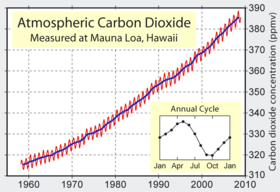
  7. The various "trigger point" levels of atmospheric CO2 that have been suggested as concentrations at which irreversible and catastrophic climate change will be initiate vary from below the current 380PPM to perhaps 450PPM will be exceeded by any reasononable extrapolation of existing trends in extraction, demand and consumption, probably reaching the neighborhood of 600PPM.
  8. ...consequently, the best strategies for those who contemplate a relatively livable future lies in adaptation to climate change...if only we could predict what that will be.
  9. Political and economic expedience and inertia simply must be accepted and worked around: it is political suicide to propose the cutbacks in consumption that would alter the basics of the unfolding scenario.
  10. The devloping countries output of CO2 is soon to exceed that of developed US and European sources.
  11. solar PV is presently too costly to deploy for a significant reduction of fossil fuel for non transportation use: A carbon tax of as much as $40/ton emitted would be needed to make it competitive...but that cost is being driven down by research.
  12. Technical fixes to the problem are not entirely beyond us but we tend to focus on overly narrow parts of the problem. Fuel used for transportation has our attention but it is only 14% of the carbon we dump in our air. A four-fold increase in the efficiency by which we take usable energy from a ton of carbon we emit would be needed...across all uses.
  13. Coal is the only fuel substance that actually tends to lie within the national borders of the countries with the biggest appetites for energy...its political strength is thus enormous despite the fact that it is by far the dirtiest energy source.
  14. In an ideal world where rational scientific choices guided politics, advanced biofuels [and that definitely does not mean the brain dead money-grab for ethanol] are one of the few things that meet sustainability criteria and for non-transportation use, solar PV is best. But for transportation, no technology yet beats the energy density you get when you gas up your car. These are the "big picture" thoughts that drive BP's research efforts.
  15. Nuclear energy breakthroughs like fusion are decades away, and even conventional nukes, ignoring their hazards, require massive up-front capital, which in turn requires strong expectation of predictable markets and political stability. In general, remedies for growing energy shortfalls using old or new technology will need investments which neither industry nor government may have the nerve to make
  16. Political mechanisms are too weak to change the price or reduce the emissions significantly but they must not fail to mitigate the impact of escalating carbon prices and climate change upon the poor.

Dr. Koonin elaborated on the adaptations [he called it "Plan B" but I don't see how these developments are anything but necessary, merest survival choices] we are likely to need:
  • hardened infrastructure
  • drought and heat adapted crop species
  • move people to where the new habitable climate zones emerge.
But Koonin also said he was excited about clathrates. That was where I began to suspect that he was, as are most car-addicted western consumers, slightly insane: in these minds, there is no such thing as a bad and cheap source of hydrocarbon fuel. Its true that there are massive amounts of methane ice locked up in a kind of sludge thought to blanket various spots at the margins of the continental shelves. And maybe that is where it should stay.

The inevitable mistake, the one conditioned by his industry and his position in that industry is to repeat without question the conventional wisdom: "We know of no way to both decrease energy use and maintain economic growth." Using less seems to me like the clearly implied mandate of the many facts and trends pointed out in the lecture but the assumption on Dr Koonin's part and probably every person in the present administration is that no one will voluntarily use less energy if they can afford to use it at all. And not once was there any suggestion that there are too many of us on the planet. In fact, several of the calculations presumed a steady march to at least nine billion people on earth before any leveling begins to occur. That is crazy. Economic growth has always been at the cost of the environment and the environment has come around to collect the rent at last.

It is a widely observed fact that when societies achieve affluence and high levels of education for all citizens, birthrates fall to near maintenance levels. The one-sentence explanation of that phenomenon is that people are living happier lives with less children. If birthrates fall only because most of us literally cannot get heat and food enough for ourselves, happiness is going to be a thing of the vanished past.

Wednesday, May 28, 2008

Perspective

I assume much of the failure to respond to climate and fossil fuel crises in a timely manner really is the gradual way they emerge. Al Gore's ridiculed frog in a pot of hot water won't seem so funny when more people are financially or physically harmed by shortages, diseases and weather calamities. The recent spike in oil prices may be a favor in disguise. I do not know why most Americans chose to ignore the warnings 30 years ago...or the many research reports since then. Consequently, I have no charitable estimate of average American intelligence and an even worse opinion of the leaders they have chosen. We have lost precious time and advantage that cannot be recovered. We have not prepared ourselves in our expectations for the reduced consumption that will be forced on us.

I am making my plans for a transition to nearly self sufficient local production of the food and energy I will consume in living and moving about for the rest of my life. Some of these plans were made long ago but only to the extent of reduced oil consumption in domestic heat and commuting. Much more may be needed in terms of changing how we farm, where we farm and how we build our homes and offices. Those elements of our life support are about to become unsustainable.

Here is a short article from a recent NY Times telling us the Bush administration has given up on its cover-up of global warming. Three cabinet members have actually signed a report that summarizes dire predictions of drought in the western US. "About time" you might say but I am saying "Too late". The times article has a small map showing where rain will increase, decrease or fall unchanged. I am sitting pretty up here in Massachusetts according to that map. Fifteen or twenty years ago, my subscription to Science News brought me a similar map. At that time, the computer models of the climate were not quite so accurate nor was as much data available but they got it nearly right. The map I saw then postulated a small increase in global temps [most of which has already come to pass] and calculated what effect that would have on circulation, jet stream etc. It predicted a drier southwestern US and a corridor of cooler air diverted from Canada across the northeastern states that would cause slight increases in precipitation. I checked NWS data history for rainfall in my area and found it has a very slight upward trend. 42 years ago, I was a high school student, reading Buckminster Fuller's "Spaceship Earth" when my classmates were reading Hot Rod magazine. When I had a chance 28 years ago, I built a solar heated house. As I now contemplate setting up a large garden or small farm, it appears I will have the rains I will need for the rest of my lifetime.

While many acquaintances my age [nearing retirement] seem eager to decamp from the nasty New England winters and move to Florida or Texas, I have never seen that as a sustainable long term option. They will be wishing they could come back north in less than 10 years because they will find the mere numbers in which they stampeded south have outstripped health care facilities and the constant smoke of burning everglades will take the shine off the sunshine state.

How does it get to be too late? How far ahead should one fix one's gaze in order to avert disasters and stave off ruin? All those horizons I mention: 10, 20 and 30 years have meaning in your life: when will you pay off your mortgage? When will heating cost more than you can afford. When will food use up your car payments or be completely unavailable? What is the right perspective?

You are eating the food and drinking the water your grandparents left you. Hows that? We cannot see more than a decade or two forward for weather. We can know the trend but not the timing for resource exhaustion. Real estate developers should be reminded land is not the only thing they stopped making, air and water too. Look forward as far as you possibly can and use every tool of science at your disposal and that will barely be adequate. If you will not trim your consumption, the most brutish and chaotic future awaits. If you will not look forward, you will back over a cliff.

Tuesday, May 13, 2008

The more things should change...

The way Toyota trounced domestic US automakers with its Prius hybrid electric car has finally been noticed. Billions in losses, and many lost factory jobs later, you can almost sign up to get a hybrid Vue or maybe that me-too runty Ford mini-SUV.

New York Times published this report of a Nissan-Renault product launching soon in Israel and scheduled to debut in the US in two years. This is an all-electric vehicle that solves the short-leash problems of decent sized/decently peppy electrics by a simple stroke: you can swap the battery for a fresh one quickly rather than wait for an hours-long recharge. The article is taking comments and maybe 1/4 of the respondents are clued in that the sustainability claims for electric cars are a hoax. The rest of the comments in reply to the question "What would get you to buy an electric car?" with pavlovian drooling about the specifications they demand in order to spend their dollars. I got annoyed at them:
The error, IMO, of most of the wish-list specifications of an acceptable "electric" car that have been set forth in these comments is that there is little understanding of the underlying collective energy consumed.

IF the electric car were driven in, say, Montreal or Tacoma, one might claim they were powered by carbon neutral [though hardly "fish neutral"] hydroelectric. Back here in Boston, the electricity I buy for my electric car would come mostly from coal burnt somewhere upwind of my driving range: environmental degradation is simply pushed into someone else's back yard though with less dependence on foreign oil. To go the greater distances gas guzzlers can cover, even with a lithium battery, requires a bigger, heavier vehicle. Moving nearly a ton of metal just so your one tush can get from here to there means more kilowatts per person mile are needed than the light electric cars now on offer. [you can't afford a Tesla!] Result: Negligible net reduction in energy consumption AND continued dependence on burning fossil fuels. You are all kidding yourselves. And baring a huge biotech breakthrough, hydrogen is just as illusory an improvement: hydrogen is primarily obtained by electrolysis of water and you only get out the watts you put in.

The one virtue of the Nissan/Renault plan as it is to be implemented in Israel is that the battery can be readily swapped for a fresh one. At the cost of doubling the number of batteries that must eventually be disposed of, a very significant power source phase issue is avoided: Most of us drive during daylight which would make conventional built-in batteries UNAVAILABLE FOR CHARGING FROM PHOTO VOLTAIC SOURCES DURING DAYLIGHT HOURS. And Israel has the sunshine.

Most of you are still thinking like the consumers you were bred to be. Unless we replace the original sources with something clean, sustainability requires that we each INDIVIDUALLY consume less energy. Period.


The electric car is not going to solve our problems. Consumption us our problem and why get excited about yet another way to consume? The possibility of entrepreneurial types putting up solar powered recharging facilities [e.g. parking garages with a roof of photovoltaic panels ] is the one viable and potentially sustainable idea that could salvage the environment that heedless consumption via electric cars would leave us. Lets just see what Exxon convinces congress to do about the licensing of such structures!

Sunday, September 16, 2007

Not much about The name change

Yes, I did read the Atwood book. As gloomy as it may sound as a forecast of trends in applied biotechnology, I do not think that is the real point of the book. The backdrop of that story is a world in which we can no longer produce the food we need, and have drowned our coastal cities. The most serious indictment in the book, to me, is the projection of the trend of emerging corporate power and the increasing lack of moral judgment or concern for effects on common citizens on the part of corporations. If Merck and Halliburton merged, how far from this "work of fiction" would we be? How little would any government's efforts matter to them?

Saturday, September 15, 2007

found another useful website

Appropedia: tree huggers get down to brass tacks.

Tuesday, September 11, 2007

about my absence

I started other blogs and mostly added my voice to a chorus of liberals and rationalists who want to wrest control of the US and stewardship of the environment away from the Bush administration and all the fundamentalists, oligarchs and cryptofascist sympathizers that prop up neoconservative political fortunes.

The din of complaints is mighty but the distant thunder of an inhospitable overburdened planet will just keep growing louder and closer. It will finally drown out even the crowd noises of this soccer game we call politics. We will look up from our petty struggles, most engaged in for the covert purposes of mere personal gain, to see dispossessed hoards, famine, disease and climatic catastrophe overrunning the tiny spoils we thought so precious.

I am back from the war. We have not won on the political front. I am going back to self sufficiency blogging.

Friday, January 28, 2005

Getting less vague

Today's link is presented only as a refinement of the justifying premises for my doing this blog. In the January 25th article in Climate Change Monitor, report of an international conference's conclusion that we can stop saying "some day it will get bad": 10 years is about all we've got left, ignoring the "minor" current problems of increased global average drought and species extinctions.

I suppose this means that I should take into account, in seeking low tech self sufficiency solutions, which solutions will operate effectively in a radically changed climate. But which way it is going to change depends a lot on your lattitude and longitude.

Monday, January 24, 2005

Joining what I can't beat...

Well, I had less time for this blog than I imagined but it aint dead yet.
Most of us would like to add something to the world, kick in our 2 cents to the debate, share our nifty new idea. My motivation in adding my bit, be it anything from ego gratification to an unstinting love for suffering humanity, won't matter if the bit I add is nothing new. I had in the back of my mind some homebrew power generation ideas when I first set out the purpose of this blog...but I see others are well along the learning curve and the community building process in this particular area. I would do more good for more readers by posting my tweaks to the good ideas presented and discussed there than by virtually hiding them in an unknown blog. I have subscribed to the OtherPower discussions and suggest, if the premise of this blog interested you, that you might be informed or entertained by a subscription as well.
But all is not lost. I will continue to check out what else is going on in energy self sufficiency on the web and see if there is some topic that needs better coverage or just more promotion.

Tuesday, June 29, 2004

Winning by not loosing

The economics of just staying warm have changed over the
course of history. If we consider the "temperate" climates
where the most industrialized and fuel intensive centers
of population exist today, the pattern of the historical
change might be characterized as a backwards "J" shaped
plot. Measured in the number of hours a household had
to devote to work that obtained fuel and kept the fires
going, we went from a lot of hard work gathering wood
to increasingly mechanized acquisition of coal and oil
and increasingly automated distribution and consumption
via electrification and increased efficiency of centralized
generation plants. What we DID NOT do , except sporadically,
was find ways to live with less energy and that non-trend
has combined with the other trends to push us to the point
of exhausting all the cheap sources of fuel. A brief
change of course in the USA after the oil embargos of the
1970's was a heartening demonstration that laws and
consciousness can be changed toward more rational use of
resources but in time, the old ways of find-more-burn-more
reasserted themselves. The bottom of the j shaped curve
has been reached and energy will take an increasing bite
from here on out.
Today's link is an example of
how thorough economic analysis shows that you can build
for strict energy conservation and wind up saving a bundle
of cash into the bargain. This page has many links:
http://nickw.worldonline.co.uk/House/links.html
Of which I particularly recommend:
http://www2.rgu.ac.uk/subj/search/Research/SustainableHousing/Sust-H-Design/Publications/zeroleaflet.htm

Monday, June 28, 2004

incentitve

I got to wondering why companies like GE or GM keep making stuff
that burns up so much energy and creates so much pollution. If
you are out of money, you would do without some things but
stuff you gotta have, food and transportation for instance, you
would go to great lenghts to find or make as your resources
permitted. You do whatever you have to in order to survive.
The thought thats with me today is that the GM's of the
world, every bit as much as persons or families, are trying
to survive. To the extent that they can buy or bend the
political powers that make the laws and taxes which affect
business makes them different from individuals but in so far
as their well being depends on coming up with goods people
will pay for and doing so at less cost than their competitors,
they are like individuals. WE are still part of the equation
and can't hope to reform the great, visible waste of industries
whose goods we still keep buying. So perhaps, rather than waiting
for the smelters and foundries to burn up the skies and dry up
for want of coal, we consumers should reform ourselves. What
we demand, the smart company will supply...I hope Toyota eats
GM's lunch by selling a ton of hybrids [to cite a hopeful trend]
The next or perhaps at least, the ultimate stage of the consumer
led revolt for sustainability might be less painful than collapse
and spotty self sufficiency by primitive means.

Friday, June 25, 2004

A few good links

What got me started on this enlightened self-sufficiency kick?
Well I was always inclined this way....I built a solar heated
house back in 1980. But a friend of mine renewed my interest
when she traded in a high tech career in the Boston area for
a cleaner, simpler life at an intentional community dedicated
to sustainability. Conversations about resource issues and
my own reading led me to believe there is much merit to the
"doom sayers" of the green left. Some URLs to check are:
http://www.culturechange.org/issue10/alternative-to-oil.htm
http://www.museletter.com/partys-over.html
http://www.bushgreenwatch.org/

That'll keep you busy for today. I will bring in a few
from time to time. I am hoping that where this ends up
is an exposition of low tech ways of reclaiming a higher
quality of life.

Thursday, June 24, 2004

but...

if this is a BLOG about how to live when the electricity
goes out, what good is it going to do us? pencil and
paper don't support blogging very well!

Dedication

Blogging has gotten so easy that no barrier prevents the creation of
Weblogs devoted to very narrow topics. Narrow but politically charged
topics will of course invite stray conversations but none the less,
let me kick _this_ one off with the following statement about the
intended topic:

The comments and the links dragged in here should focus on practical
means of living or making a living that will still work after or
in spite of the collapse of wastefuel [yes, a coinage] industrial
and lifestyle practices. Greenies won't need this preaching and
most Democrats and all Republicans won't even know what we are
talking about. Somewhere underneath all the hyperbole and mistrust
there are simple things that real people can do, without needing
a law or a subsidy, to put food on the table, keep their water
clean and ward off frostbite. If all you are worried about is
how you are going to pay for your kids college, zoom out to a
bigger picture...in what world are they going to apply that
expensive education? What are education and for that matter,
money, going to mean when no amount of money will drag another
barrel of oil out of anybody's patch of this earth? Almost by
definition, the means and ways we hope to discover links for or
see discussed here cannot cost much. The solutions presented here
may not have an obvious or at least economically compelling
problem in the strangely naive world of 2004 U.S.A. but the bias
and assumption expected in this blog is that the matter is one
of when, not if, these problems will emerge.
Think "socialist survivalist with a Phd" and you may be in tune
with this blog.